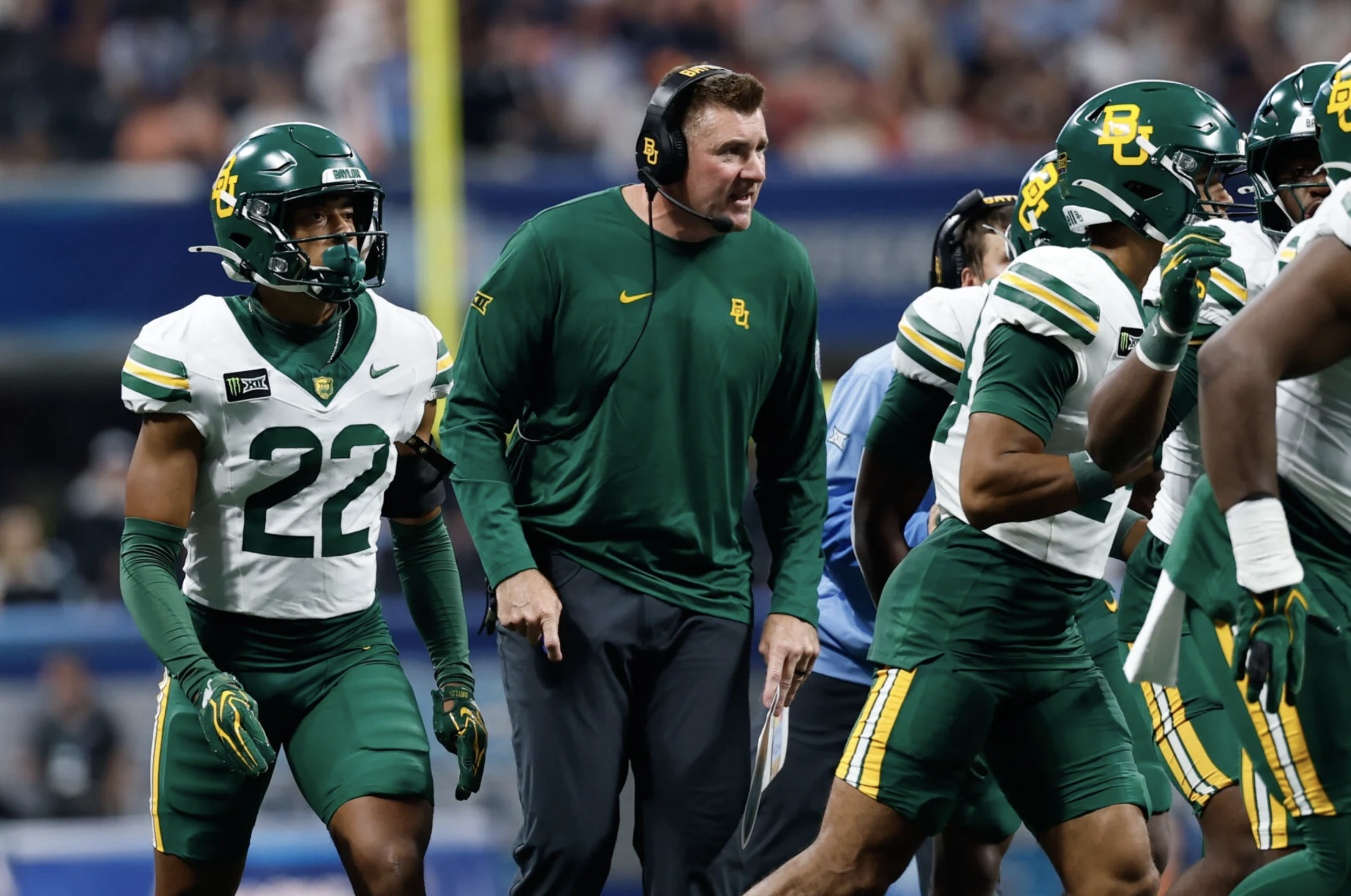
When Joe Klanderman hung up his football cleats for the final time as a player at Minnesota State in 2001, he headed for the classroom.
But after just a few weeks as a student teacher, he decided he wanted to apply that passion to the game he loved, and he quickly joined the staff at his alma mater to start his football coaching journey.
He’s been teaching ever since.
“If all you do is play football and get a degree and you haven’t taken anything else away from me, then I probably failed you,” Klanderman said.
Klanderman has been consistent, loyal, and successful throughout his coaching career at Minnesota State, North Dakota State, Kansas State, and now Baylor, where he is in his first year as defensive coordinator.
At his core, nothing has changed.
He’s still a teacher at heart.
“There are a lot of smart football coaches out there, but if you can’t get players to understand and believe in what you’re teaching, you become a very average coach,” said Chris Klieman, who coached with Klanderman for 14 years at North Dakota State and Kansas State.
“That, in my opinion, is Joe’s biggest strength.”
Multiple times this season, Klanderman has called in play for the defense, only for the opposing offense to switch things up. With the play clock running down, Klanderman sometimes decides to make another call from the sideline to counter that move on the fly.
The first time that happened, Baylor head coach Dave Aranda stiffened up, almost in shock.
“And it was a tackle for loss,” Aranda said. “The guys are loose and free. His way of teaching where guys can take sudden changes and kind of roll with it and play with confidence is way cool.
“In not even a year, the relationship that Joe has with the defense and how they’ve communicated and how they’ve taught, it’s so understood.”
Klanderman was the defensive coordinator at Kansas State in 2021 when he watched Jarion McVea make a goal-line stop for Baylor to help the Bears beat Oklahoma State and win the Big 12 Championship.
He remembers thinking it doesn’t get any better than that play.
One year later, the Wildcat defense that Klanderman was calling stuffed TCU on the goal line, and they went on to win the Big 12 title for the first time in a decade.
“When you do things like that, you really get to the guts of who people are, and they take their masks off, so to speak,” Klanderman said. “Those are the relationships that get built forever. When you break down those walls with guys, that’s when the special stuff happens.”
Made in Mankato
Klanderman’s stats as a player at Minnesota State don’t jump off the page.
In 30 career games along the defensive line, he had 58 tackles, 7.5 TFLs and 2.5 sacks, and the Mavericks went 16-28.
His 12-year run as an assistant coach at his alma mater saw the Mavericks have much more notable and memorable results, while he stuck around to work alongside three separate head coaches.
“I was like a cockroach over there; they couldn’t get rid of me,” Klanderman said.
Jeff Jamrog was a late arrival in the summer of 2004.
After leaving Nebraska following the 2003 season, he accepted a defensive coordinator position in Illinois, only to then be offered the head coaching job at Minnesota State, where Klanderman was in his third year as a restricted-earning coach making about $4,000 a year.
By the time 2007 rolled around, Jamrog was looking for a defensive coordinator, and after talking to everybody in the building, realized Klanderman was who should get the job, lack of experience aside.
“At the end of the day, it just felt like he was the right guy,” Jamrog, the current head coach at Midland University, said. “He had a great passion for the university, and I knew he was going to work extremely hard. I knew he was always going to try to find answers.”
When Todd Hoffner arrived in 2008, he retained every coach on the staff, but also gave them the chance to leave if they didn’t want to do things the way he wanted things done.
“He was really connected to the student-athletes,” Hoffner said. “When he was here, he had some deep fibers and some deep connections with everybody that played for him on the whole defensive unit.”
And they started winning.
The Mavericks won the Northern Sun Intercollegiate Conference South Division and qualified for the FCS playoffs for the fourth time in school history. They won 10 games and made another NCAA appearance in 2010.
Klanderman’s defensive units were a big reason why, forcing 34 turnovers (24 interceptions, 10 fumbles) in 2008, and 38 (29 interceptions, nine fumbles) in 2009.
“We went through some tough times, and he was always a great soldier,” Hoffner said. “We had to transition a program that hadn’t won a lot of games, and we had to make some big changes, but I thought that he always adhered to what was asked of him.”
Across 12 seasons at Minnesota State, Klanderman had 26 players earn first-team all-conference honors and coached 10 All-Americans. The Mavericks won at least nine games in five seasons that he was on staff.
“I would have been happy being there for the rest of my life,” Klanderman said. “I’m not the coach that’s going to move around and look for other opportunities; that’s not really my jam.”
From Bison to Wildcats
As the defensive coordinator at North Dakota State, Klieman was in charge of helping run football camps with thousands of prospects from across the upper Midwest.
The Bison coaching staff would invite other DII schools from across the region to come, including Minnesota State, a routine that continued for the two years that Klieman was the defensive coordinator at North Dakota State in 2012 and 2013.
When Klieman became the head coach in 2014, he wasn’t just recruiting the players from his camp.
“I hit it off with Joe right away just talking football,” Klieman said. “I appreciated that he was kind of a football junkie. He is super intelligent as a coach and had a personality that mixed well with everybody.”
Klieman said he never sensed that Klanderman was nervous or intimidated, but going from a play-calling role like the one he had at Minnesota State to just coaching defensive backs was an adjustment.
“He quickly made a name for himself with (then NDSU defensive coordinator Matt) Entz and myself that his opinion mattered if we needed to hear from him,” Klieman said. “I wanted him to put his own stamp on it, and he always did that.”
The Bison won. A lot.
Four national championships in five years, in fact.
The Bison ranked in the top five nationally in scoring defense all five seasons and finished with 100 interceptions, including 23 in 2018, the best in the nation.
“It was amazing,” Klanderman said. “The expectations are such that if you don’t win the whole thing … you would’ve thought the sky was falling. It was a stressful job. You felt that pressure every week.”
Klanderman was one of four North Dakota State coaches to follow Klieman to Kansas State ahead of the 2019 season.
When Klieman was looking for a defensive coordinator in 2020, Klanderman had been interviewing for the job for the last six years.
“I was in that room enough to know that he earned the respect of the other coaches,” Klieman said. “Everybody on the staff agreed that Joe was the guy who should be elevated. When we announced it, the players were excited because of the continuity on the staff, but also the fact that Joe was smart and knew what he was doing.”
The Wildcats flourished.
Klanderman’s defenses held their opponents to under 22 points per game in his first four seasons, and have ranked in the nation’s top 30 in defensive efficiency rating over the last five years.
They continued to cause havoc and finished with the fourth-most turnovers forced (26) in the nation last year.
“We improved over the last few years at K-State because we let the D-line be way more aggressive,” Klieman said. “We were a read-and-react team early on, and then we had to change and be more downhill and take shots on the D-Line. It leads to more overthrows.”
When Klieman retired after last season, their 14-year relationship on the football field ended.
Klanderman said Klieman has been the biggest influence on him and the way he coaches.
“How great of a human being he was and how honest he was,” Klanderman said. “How he handled players, and how he handled coaches, he’s just a top-notch individual.”
Klieman is confident that Klanderman is going to continue to climb.
“Joe is going to be a head coach,” Klieman said. “I don’t know when it’s going to happen; it’s got to be the right situation. But Joe is built to be a head coach and run his own program if he gets that opportunity.”
Blooming on the Brazos
Klieman and Aranda, both defensive-minded coaches, are good friends.
When Klanderman came up, the conversation was easy.
“When Dave called me, that was a really simple sell, because I think Joe is one of the best in the business,” Klieman said. “He’s proving that again this year.”
Baylor’s defense is in the midst of a historic stretch, holding each of its first five opponents to 20 points or less to open the season, the first such five-game streak since 1986.
The Bears rank 11th in the country in scoring defense (14.2 points per game) and are 45th in total defense, including 95th against the pass and 22nd against the run.
They rank eighth in the country in sacks (18), 14th in TFLs (42), and are 19th in turnovers (10).
“They have a lot of pride,” Aranda said. “I think the players are really playing for him. They are giving second effort and are sacrificing for him and for the team. You see guys playing together. Regardless of what the score is, or regardless of how much time is left in the game, they’re still competing, and that is a rare, rare thing.”
For the last two years, Aranda, who won a national championship as the defensive coordinator at LSU, has been calling plays in addition to his role as the head coach.
When Klanderman was hired, he made it clear that he wanted to do things his way.
“I didn’t know the dynamics of what had gone on here in the past, and I really didn’t care,” Klanderman said. “I told him in the process that if I’m gonna do this, I want to do it all-in and my way.”
Aranda was in full support.
It’s enough to have to do the day-to-day job of the head coach, let alone also be calling plays as the de facto defensive coordinator. Aranda is noticeably looser and healthier this season now that he is focused on one thing.
But that doesn’t mean Klanderman never seeks him out.
“If we’re ever stuck, he’s the guy you can go to and be the tiebreaker,” Klanderman said. “Maybe there’s an idea that’s out of left field that none of us are thinking about. Our staff, there are some young stars in that room, but we’re young. Sometimes those guys don’t have the experience of Coach Aranda, who has been in the business for so long.”
Klanderman was just crawling with the Baylor defense in the spring, learning to walk in fall.
By this point, they’re running.
Klanderman the teacher has been out in full force.
“You can talk to him about anything,” safety Micah Gifford said. “You can joke around with him and have a smile on your face all day. It’s not like you’re walking around all stiff. It’s really a calm, fun environment where it’s easy to learn and easy to pick up on stuff.”
If his time at Minnesota State, North Dakota State and Kansas State is any indication, the defense improves as the seasons go on.
“It’s gonna get better, hopefully,” Klanderman said. “It’s the first time some of these guys see different pictures. You get into a game, and there are some things you haven’t repped or seen. Do they understand the rules and principles well enough to apply the rules and principles?
“It’s such a fun group to be around, but there are definitely things we can still work on. We’re on our way.”