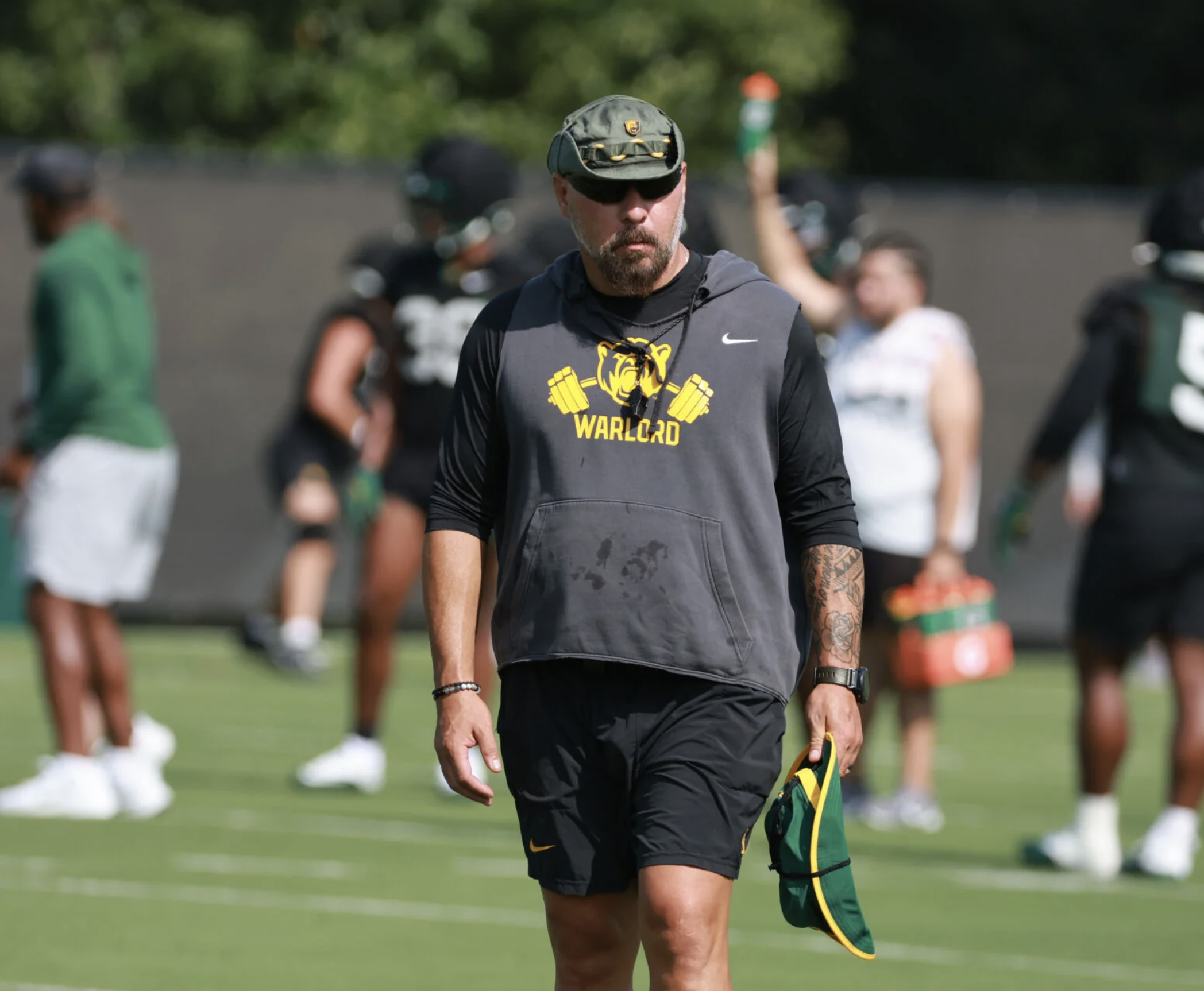
Vic Viloria’s high school and college coaches used many words to describe him as a middle linebacker.
Old school. Tough. Throwback.
As his playing career progressed through high school, SMU, and, ultimately, professional football, the adjectives he once thought were compliments came to represent something very different.
“What I realized was they were saying I was short and slow,” Viloria said. “I had to learn how to maximize any ounce of skill that God and genetics gave me. I had to do that in the weight room and through training.”
Viloria always knew he wanted to get into coaching, but as he sat in football meetings and dissected the intricate details and tactics of football, he didn’t feel the fulfillment he hoped for.
The weight room was his happy place.
In his more than 20 years as a strength coach, Viloria has won two national championships and helped countless players get drafted. He will begin his sixth season as Baylor’s Director of Athletics Performance this fall.
He credits Tommy Moffitt with teaching him that he could train other parts of his body to supplement some of his physical limitations and being the first one to show him that it could be a career.
Moffitt is widely considered one of the best strength & conditioning coaches in the country. He won three national championships during his 21-year tenure at LSU, and has been the Director of Football Strength & Conditioning at Texas A&M since 2024.
He also got his start at John Curtis High School in New Orleans at the same time Viloria was a student.
“He had no fear; zero fear,” Moffitt said. “I’ve thought highly of him because he’s never been afraid of anything, no matter what the task was. He was tough. He loved football. He was nasty on the field.
“In my career, the guys who had to work really hard and are gym rats make your best strength coaches. Most of your best strength coaches are overachievers.”
Or old-school middle linebackers.
“Football is a game of alignments and stuff, but once the ball snapped, it's about violence and running and jumping and hitting and strength and speed,” Viloria said. “Maybe I wasn't smart enough to do the X's and O’s.
“Or maybe I was just the traditional crazy middle linebacker that liked to run and hit people.”
From Baton Rouge to Baylor
When Moffitt got to LSU in 2000, there wasn’t anyone on the Tigers’ staff to teach the brand of strength & conditioning that he wanted, so he reached out to his old boss from John Curtis to see if there were any students on campus who could volunteer.
After Viloria’s time at SMU ended and he played for the Scottish Claymores of NFL Europe, he found out that some of his high school friends had reunited with Moffitt at LSU.
Viloria wanted in.
“He came over and volunteered and said he wanted to learn to be a strength coach,” Moffitt said.
In addition to Moffitt and Viloria, the LSU strength staff at the time included Scott Cochran, who would win five national championships at Alabama, and Joe Danos, currently the Director of Sports Science with the Denver Broncos.
Viloria got used to the system and terminology of his old high school strength coach. He thought it would be an easy transition when he got his first job as the head S&C coach at SMU, his alma mater, in 2007.
In addition to football, he worked with the Mustangs’ baseball and women’s golf teams. He very quickly learned that back squats for an offensive lineman and a golfer were two very different things.
“I wasn’t nervous, but I think I was totally oblivious and naive to what things were out there,” Viloria said. “I only knew one way. I realized that they were two different types of athletes, and the starting points were different. I had to adjust my training based on what they needed and not on what I thought was best.”
When former LSU assistant Jimbo Fisher took the Florida State job in 2010, one of his first calls was to Moffitt, who immediately recommended Viloria for the strength & conditioning position with the Seminoles.
In his seven seasons in Tallahassee, the Seminoles posted a record of 85-20 with six bowl wins, including four consecutive New Year's Six Bowls, won three ACC titles, and won the 2013 BCS National Championship with a perfect 14-0 record.
Viloria said he didn’t change anything in the weight room after 2012, when FSU finished 12-2. All the motivation for the undefeated, title-winning season in 2013 came from the players, and the realization that they came so close the year prior.
“Before (2013) year started, we all said that we're not doing that again,” Viloria said. “In week five, when it kind of gets monotonous, instead of me having to bring out more crazy middle linebacker volume, a player stood up and said, ‘No, today, we're not doing that.’”
When Fisher left Florida State for Texas A&M, Moffitt convinced Viloria to return to LSU.
In addition to hiring guys who played football, Moffitt assigns the members of his staff to the positions that they played. So Viloria, the former middle linebacker, worked closely with the rising defensive coordinator, Dave Aranda.
The two hit it off immediately.
Besides their routine conversations about personnel and football at LSU, they’re also both very cerebral and deep thinkers. Both of them express their crazy middle linebacker energy in vastly different ways.
“I trust Vic,” Aranda said. “He’s someone who can relate to all sides. If it’s abstract, pie in the sky, and forward-thinking, he can communicate and exist in that room. If it’s primal and way aggressive and just the facts kind of stuff, he can thrive in that room. His superpower is really to talk in both rooms and be a strong force in both.
“Why that matters is that he can bring great science and analytics into a really hardworking and great effort-producing, tough environment. Our kids are getting the best of both worlds.”
The game has changed from back in the day, when one strength coach could go through multiple coaching staffs. For the last decade, the assistants have been more tied to the head coach than ever before.
Viloria watched Aranda work at LSU, and while he was different from most coaches, it was a style and a tempo that he knew he wanted to be a part of.
“I saw this opportunity as a place that I could come and really, really, really make a difference,” Viloria said. “It didn't happen in a better way. This is exactly where I need to be at this moment in my career, and I'm blessed to be around a coach that allows me to do my job.
“If this place wants to be consistent and have a program that they're proud of, this way may be taking longer than most would like, but it's a sustainable method.”
Forged in Waco
Jairon McVea was not the most heralded prospect coming out of high school.
Despite leading George Ranch High School to an undefeated season and a state title and being named the district’s defensive MVP in 2015, he decided to attend Baylor as a walk-on defensive back.
“I was always one of the smallest guys on the field, so I always had to be as strong and as fast as I could be to have a chance,” McVea said. “That’s something I always took seriously. I’d try to do extra things. That’s something you have to do in college football.”
He had three different strength coaches — Kaz Kazadi, Jeremy Scott and Corey Campbell — in his first four years with the Bears. His fifth and final year was spent with Viloria, and he made it count.
McVea tied his career-high with nine tackles in the Big 12 Title game against Oklahoma State, the last of which will live on in Baylor lore for eternity.
“That’s what I carried with me throughout football: to prepare for moments like that,” McVea said. “Not just me, but all the extra hours that everybody on the team was putting in to prepare for that last second. All that extra work played off, for sure.”
Those are the kinds of things that get Viloria fired up.
“That's conditioning, that's fitness, that's mental toughness, that's strength,” Viloria said. “All of it being expressed on the field. You get a guy that should not be there making this astonishing play, and everybody goes, ‘How? Was that a miracle?’ No, that guy had worked that hard all off-season, all summer. No one saw him, but I was not surprised at all.”
It’s hard to measure success as a strength coach.
You can look at a top-ranked offense or defense, but that doesn’t always translate to wins. You can get the blue-chip athletes and compile the best recruiting class, but it doesn’t mean anything without work in the weight room.
“I think success comes from spending time in here and then seeing how much of that transfers to the field,” Viloria said. “It's hard to place a stat on that.”
This season has been a shift.
Aranda said on the first day of fall camp that the Bears did a lot more running and agility than they had, while they focused on doing more reps with lighter weights in order to keep people healthy.
The line of scrimmage saw the biggest changes from the fall to the spring.
Defensive linemen Daemian Wimberly, Jackson Blackwell, Devonte Tezino and Jamaal Wyce all lost 10 or more pounds, while offensive linemen Alessandro Lorenzetti, Keystone Allison, Nate Kibble and Koltin Sieracki all added 10 or more pounds.
Viloria said he’s started to adopt an NFL-style training plan rather than a rigid system.
“We want to meet them where they are, make sure they're hitting those targets, and then adjust based on their needs and our coaches' needs,” Viloria said. “I stopped training based on what I feel is best, and I looked at it more in terms of what they need and what coaches need.”
There are moments when Viloria will see a guy make a block that springs a big run or a play that, perhaps, they didn’t expect they could make.
They’ll give Viloria a look that says, ‘How did I do that?’
“I've always enjoyed having the ability to watch a guy that people doubt or don't think can do it, but then they work, and they invest, and they do the stuff when nobody is watching,” Viloria said. “When they have that success on the field, those are the moments that I count as positive stats.
“That’s the cool part.”